Chemistry Net: 2017

Periodic Table with Bond Dissociation Enthalpies

Periodic Table with Bond Dissociation Enthalpies

Periodic Table with Bond Dissociation Enthalpies EH(A-A)


Bond dissociation enthalpies (energies) for bonds A-A at 298 K and 1 atm pressure are given in Table 1. Average values of bond dissociation enthalpies of the A-B bond in a series of different compounds are given in the post "Bond Dissociation Enthalpies"


Table 1: Bond Dissociation Enthalpies EH (A-A) (kJ/mol) at 298 K and 1 atm
1 2 3 4 5 6 7 8 9 10 11 12

H

436


Li

102.8

Be

9.46


Na

72.6

Mg


K

54.8

Ca


Sc


Ti


V


Cr


Mn


Fe


Co


Ni


Cu


Zn


Rb

51.0

Sr


Y


Zr


Nb


Mo


Tc


Ru


Rh


Pd


Ag


Cd


Cs

44.8

Ba


La


Hf


Ta


W


Re


Os


Ir


Pt


Au


Hg


Fr


Ra


Ac


Th


Pa


U


Np


Table 1 (continued...)
13 14 15 16 17

B

295

C

178

N

945

O

498

F

158

Al

167

Si

317

P

485

S

429

Cl

243

Ga

116

Ge

280

As

383

Se

308

Br

193

In

106

Sn

192

Sb

289

Te

225

I

151

Tl

˜63

Pb

61

Bi

194

Po


At

110


References

  1. CRC Handbook of Chemistry and Physics, 52nd edition, The Chemical Rubber Co., (1971)
  2. David W. Oxtoby, H.P. Gillis, Alan Campion, “Principles of Modern Chemistry”, Sixth Edition, Thomson Brooks/Cole, 2008
  3. Steven S. Zumdahl, “Chemical Principles”  6th Edition, Houghton Mifflin Company, 2009

Key Terms

bond enthalpies, bond dissociation enthalpies, table with bond dissociation enthalpies,


Atomic Radius Periodic Table of the Elements

Atomic Radius Periodic Table of the Elements

Periodic Table with Atomic Radius


Atom size values cannot be specified exactly. These values can be obtained by measuring the distances between atoms in chemical compounds. Measurements of this type have led to the values of atomic radii for the elements shown below.


Table 1: Periodic Table with Atomic Radii (Å) of the elements
1 2 3 4 5 6 7 8 9 10 11 12

H

0.37


Li

1.52

Be

1.13


Na

1.86

Mg

1.60


K

2.27

Ca

1.97

Sc

1.61

Ti

1.45

V

1.31

Cr

1.25

Mn

1.37

Fe

1.24

Co

1.25

Ni

1.25

Cu

1.28

Zn

1.34

Rb

2.47

Sr

2.15

Y

1.78

Zr

1.59

Nb

1.43

Mo

1.36

Tc

1.35

Ru

1.32

Rh

1.34

Pd

1.38

Ag

1.44

Cd

1.49

Cs

2.65

Ba

2.17

La

1.72

Hf

1.56

Ta

1.43

W

1.37

Re

1.34

Os

1.34

Ir

1.36

Pt

1.37

Au

1.44

Hg

1.50

Fr

~2.7

Ra

2.23

Ac

1.88

Th

1.80

Pa

1.61

U

1.38

Np

1.30


Table 1 (continued...)
13 14 15 16 17

B

0.88

C

0.77

N

0.70

O

0.66

F

0.64

Al

1.43

Si

1.17

P

1.10

S

1.04

Cl

0.99

Ga

1.22

Ge

1.22

As

1.21

Se

1.17

Br

1.14

In

1.63

Sn

1.40

Sb

1.41

Te

1.43

I

1.33

Tl

1.70

Pb

1.75

Bi

1.55

Po

1.67

At

1.40


References

  1. CRC Handbook of Chemistry and Physics, 52nd edition, The Chemical Rubber Co., (1971)
  2. David W. Oxtoby, H.P. Gillis, Alan Campion, “Principles of Modern Chemistry”, Sixth Edition, Thomson Brooks/Cole, 2008
  3. Steven S. Zumdahl, “Chemical Principles”  6th Edition, Houghton Mifflin Company, 2009

Key Terms

atomic radius, periodic table with atomic radius,


Comparing several group means by one-way ANOVA - Post Hoc tests using SPSS

Comparing several Group Means by ANOVA using SPSS

Comparing of several Group Means by One-Way ANOVA using SPSS - Post Hoc Tests

In a previous post entitled "Comparing several Group Means by One-Way Anova using SPSS" the one-way ANOVA test was presented. An example was given where the situation encountered was to compare mean results for the concentration of an analyte obtained by threel different methods. The dependent variable was the mean analytical results (labeled Analytical_Result_g) while the independent variable was the method used (labeled Method)

It is common in analytical work to run experiments in which there are three, four or even five levels of the independent variable (that can cause variation of the results in addition to random error of measurements) and in these cases the technique called analysis of variance (ANOVA) is used. ANOVA is an extremely powerful statistical technique for analysis of data that has the advantage that it can be used to analyze situations in which there are several independent variables (or better several levels of the independent variable).

The output of the ANOVA test showed that the mean results of the concentration of the analyte by the three methods used were not equal. In this post we are going to answer which mean differs from which mean by using Post Hoc tests. Post hoc tests (also called post hoc comparisons, multiple comparison tests, follow-up tests) are tests of the statistical significance of differences between group means calculated after - "post"- having done an analysis of variance (ANOVA) that shows an overall difference. The F ratio of the ANOVA indicates that some sort of statistically significant differences exist somewhere among the groups being studied. Post hoc analyses are meant to specify what kind and where.

There are various Post Hoc tests such as: Tukey's Honestly Significant Difference (HSD) test, Scheffe test, Newman-Keuls test and Duncan's Multiple Range test. If the assumption of homogeinity of variance has been met (equal variances assummed) - in our case has been proven in our previous post entitled "Comparing several Group Means by One-Way Anova using SPSS" - Tukey's test is used.

There are many ways to run the exact same ANOVA in SPSS. This time the General Linear Model is going to be used because it will provide us with an estimate for the effect size of our model (labeled as partial eta squared). The effect size will show us what percentage of the variance of the analytical results (of the dependent variable) can be accounted to the different methods used (of the independent variable).

Let us use again the same Example I.1

Example I.1

Figure I.1 shows the analytical results obtained regarding the weight of Au (in grams/ton) in a certified reference material X. Three different methods (Method 1, 2 and 3) were used for the determination and six replicate measurements were made in each case. Is there a significant difference in the means calculated by each method?

Weight of Au (grams/ton) in a certified reference material X determined by 3 different methods - Example ANOVA

In SPSS access the main dialog box using Analyze --------> General Linear Model --------> Univariate (Fig. I.1)

Selecting the General Linear Model, univariate  in SPSS and run the ANOVA test

In SPSS select as Dependent Variable: Analytical_Result_g and as Fixed Factor (independent variable): Method (Fig. I.2). Select also Post Hoc and Options tests.
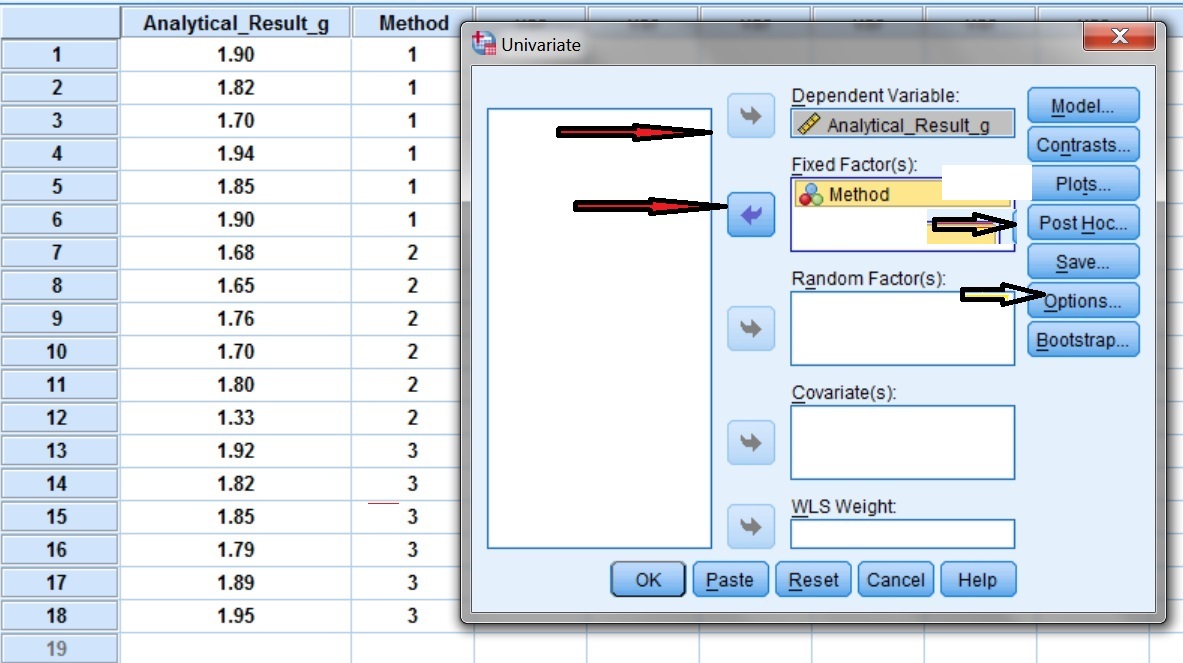
Selecting the Dependent variable (Analytical _Result_g) and the Independent Variable (Method)

The selection Post Hoc is pressed (Fig. I.3) and the independent variable method is selected for the Post Hoc tests (Fig. I.3). Then select the Tukey test and click Continue.

The SPSS dialog box for Post Hoc tests: The  Tukey test is selected

The selection Options is pressed (Fig. I.4) and the Estimates of the effect size is selected. Continue is pressed.

The SPSS dialog box Options: estimates of effect size and homogeinity tests are selected

The SPSS ANOVA output of Between Subjects Effects is shown in Fig. I.5. The mean results for the dependent variable Analytical_Result_g obtained by the 3 different methods differ significantly since the p value denoted by Sig = 0.009 < 0.05. The result for the p value - as expected -is exactly the same with that obtained in the previous post mentionned above. However, an estimate of the effect size is given by this ANOVA test labeled as Partial Eta Squared. The different methods used account for some 47% (given as .470) of the variance in the means of the Analytical_Result_g.

The SPSS Output for Between Subjects Effects with an estimate of the effect size given as partial eta squared

From the results shown in the output of Between Subjects Effects (Fig. I.5) it appears that the 3 means compared differ significantly. But exactly which mean differs from which mean?

Certainly, histograms and the mean table that were given in the post "Comparing several Group Means by One-Way Anova using SPSS" gave us a clue. A more formal answer is given by the Tukey's test in the Multiple Comparisons table (Fig. I.6). Statistically significant mean differences are flagged with an asterisk (*). For instance, the very first line indicates that Method 1 has a mean value 0.2 higher than the mean value of Method 2 and this is statistically significant since Sig = 0.023 < 0.05. Also since the confidence interval is not including zero means that zero difference between these means is unlikely.

The SPSS Output for Post hoc Tests


Method 3 has a mean value 0.02 higher than the mean value of Method 1 and this is not statistically significant since Sig = 0.958 > 0.05. Also since the confidence interval is including zero means that zero difference between these means is likely.


References

  1. D.B. Hibbert, J.J. Gooding, "Data Analysis for Chemistry", Oxford Univ. Press, 2005
  2. J.C. Miller and J.N Miller, “Statistics for Analytical Chemistry”, Ellis Horwood Prentice Hall, 2008
  3. Steven S. Zumdahl, “Chemical Principles” 6th Edition, Houghton Mifflin Company, 2009
  4. D. Harvey, “Modern Analytical Chemistry”, McGraw-Hill Companies Inc., 2000
  5. R.D. Brown, “Introduction to Chemical Analysis”, McGraw-Hill Companies Inc, 1982
  6. S.L.R. Ellison, V.J. Barwick, T.J.D. Farrant, “Practical Statistics for the Analytical Scientist”, 2nd Edition, Royal Society of Chemistry, 2009
  7. A. Field, “Discovering Statistics using SPSS” , Sage Publications Ltd., 2005

Key Terms

comparing several means, analysis of variance,post hoc tests, ANOVA, t-tests,


Ionic Radius Periodic Table of the Elements

Ionic Radius Periodic Table of the Elements

Periodic Table with Ionic Radius


Ion size plays an important role in determining the structure and stability of ionic solids, the properties of ions in aqueous solution, and the biological effects of ions. As with atoms, it is impossible to define precisely the sizes of ions. Ionic radii are determined from the measured distances between ion centers in ionic compounds. A table of ionic radii is given below.


Table 1: Periodic Table with Ionic Radii (Å) of the elements
1 2 3 4 5 6 7

H

1.46


Li

0.68

Be

0.31


Na

0.98

Mg

0.66


K

1.33

Ca

0.99

Sc

0.81

Ti

0.68


V

0.59 (+5)

0.63 (+4)

0.74 (+3)

0.88 (+2)


Cr

0.63 (+3)

0.89 (+2)

Mn

0.80 (+2)

Rb

1.48

Sr

1.13

Y

0.93

Zr

0.80


Nb

0.69 (+5)

0.74 (+4)


Mo

0.62 (+6)

0.70 (+4)

Tc


Cs

1.67

Ba

1.35

La

0.85 (+3)

Hf

0.78

Ta

0.68 (+5)


W

0.62 (+6)

0.70 (+4)


Re

0.56 (+7)

0.27 (+4)

Fr

˜1.8

Ra

1.43

Ac


Th


Pa


U


Np


Table 1 (continued...)
  8 9 10 11 12


Fe

0.60 (+3)

0.72 (+2)


Co

0.63 (+3)

0.72 (+2)

Ni

0.69 (+2)


Cu

0.72 (+2)

0.96 (+1)

Zn

0.74 (+2)


Ru

0.68 (+3)

Rh

0.68 (+3)


Pd

0.65 (+4)

0.80 (+2)


Ag

0.89 (+2)

1.26 (+1)


Cd

0.97 (+2)

1.14 (+1)


Os

0.69 (+6)

0.88 (+4)

Ir

0.68 (+4)


Pt

0.65 (+4)

0.80 (+2)


Au

0.85 (+2)

1.37 (+1)


Hg

1.10 (+2)

1.27 (+1)


Table 1 (continued...)
13 14 15 16 17 17

B

0.23 (+3)


C

0.15 (+4)

2.60 (-4)

N

1.71 (-3)

O

1.40 (-2)

F

1.33

He


Al

0.51 (+3)


Si

0.42 (+4)

2.71 (-4)


P

0.44 (+3)

2.12(-3)


S

0.29 (+6)

1.84 (-2)

Cl

1.81

Ne


Ga

0.62 (+3)


Ge

0.53 (+4)

0.73 (+2)


As

0.46 (+5)

0.58 (+3)

2.22 (-3)


Se

0.42 (+6)

1.98 (-2)

Br

1.96

Ar


In

0.81 (+3)


Sn

0.71(+4)

0.93 (+2)


Sb

0.62 (+5)

0.76 (+3)

2.45 (-3)


Te

0.56 (+6)

2.21 (-2)

I

2.20

Kr


Tl

0.95 (+3)


Pb

0.84 (+4)

1.20 (+2)

Bi

0.96 (+3)

Po

0.67 (+6)

At

˜2.27

Xe


References

  1. CRC Handbook of Chemistry and Physics, 52nd edition, The Chemical Rubber Co., (1971)
  2. David W. Oxtoby, H.P. Gillis, Alan Campion, “Principles of Modern Chemistry”, Sixth Edition, Thomson Brooks/Cole, 2008
  3. Steven S. Zumdahl, “Chemical Principles”  6th Edition, Houghton Mifflin Company, 2009

Key Terms

ionic radius, , ionic size, ionic radius table,


Ionization Energy Periodic Table of the Elements

Ionization Energies Periodic Table of the Elements

Periodic Table with Ionization Energies


The ionization energy of an atom or ion is the minimum energy required to remove an electron from the ground state of the isolated gaseous atom or ion. The first ionization energy, I1, is the energy needed to remove the first electron from a neutral atom.

M (g) —› M+ (g) + e-

It is related to the atom's electronegativity and electron affinity. Tables of electronegativities and electron affinities were given in the posts entitled "Electronegativities Periodic Table of the Elements" and "Electron Affinities Periodic Table of the Elements". A table of first ionization energies of the elements is given below.


Table 1: Periodic Table with Ionization Energies (kJ/mol) of gaseous atoms of the elements
1 2 3 4 5 6 7 8 9 10 11 12

H

1312.00


Li

520.2

Be

899.4


Na

495.8

Mg

737.7


K

418.8

Ca

589.8

Sc

631

Ti

658

V

650

Cr

652.8

Mn

717.4

Fe

759.3

Co

758

Ni

736.7

Cu

745.4

Zn

906.4

Rb

403.0

Sr

549.5

Y

616

Zr

660

Nb

664

Mo

684.9

Tc

702

Ru

711

Rh

720

Pd

805

Ag

731.0

Cd

867.7

Cs

375.7

Ba

502.9

La

523.5

Hf

654

Ta

761

W

770

Re

760

Os

840

Ir

880

Pt

868

Au

890.1

Hg

1007.0

Fr

˜400

Ra


Ac


Th


Pa


U


Np


Table 1 (continued...)
13 14 15 16 17 17

B

800.6

C

1086.4

N

1402.3

O

140.98

F

1681.0

He

2372.3

Al

577.6

Si

786.4

P

1011.7

S

200.41

Cl

1251.1

Ne

2080.6

Ga

578.8

Ge

762.2

As

947

Se

194.97

Br

1139.9

Ar

1520.5

In

558.3

Sn

708.6

Sb

833.7

Te

190.15

I

1008.4

Kr

1350.7

Tl

589.3

Pb

715.5

Bi

703.3

Po

˜180

At

˜930

Xe

1170.4


References

  1. CRC Handbook of Chemistry and Physics, 52nd edition, The Chemical Rubber Co., (1971)
  2. David W. Oxtoby, H.P. Gillis, Alan Campion, “Principles of Modern Chemistry”, Sixth Edition, Thomson Brooks/Cole, 2008
  3. Steven S. Zumdahl, “Chemical Principles”  6th Edition, Houghton Mifflin Company, 2009

Key Terms

electron affinities, electronegativity difference, electron affinity, ionization energy,