Chemistry Net: Analytical Chemistry - Acid & Base Equilibria
Showing posts with label Analytical Chemistry - Acid & Base Equilibria. Show all posts

Analytical Chemistry - Acid & Base Equilibria

Acid & Base Equilibria

ACID & BASE EQUILIBRIA - STRONG ACIDS & BASES


ACID & BASE EQUILIBRIA - WEAK ACIDS & BASES


Acid-base chemistry is important in a wide variety of every day applications. The rates of reactions that maintain our lives all critically depend on the acidity or basicity of solutions. Acids and bases and their equilibria are also important industrially and in a variety of chemical processes. They are intimately coupled to many of the processes involved in synthetic and analytical chemistry, including reaction rates and selectivity, solubility equilibria, partition equilibria, catalytic cycles and chromatographic retention times. Furthermore, mechanistic investigations and the development of manufacturing processes rely frequently in acid-base chemistry. Acids and bases are consequently important from simple reactions in the chemical laboratory to those complex reactions in our environment (acid rain, corrosion) and in industrial processes.

An introduction to basic and intermediate aspects of acid-base chemistry and their equilibria is presented in the topics listed above.


References

  1. D. Harvey,  “Modern Analytical Chemistry”, McGraw-Hill Companies Inc., 2000
  2. R.D. Brown, “Introduction to Chemical Analysis”, McGraw-Hill Companies Inc., 1982
  3. S.M. Khopkar, “Basic Concepts of Analytical Chemistry” , New Age Int. Ltd. Publishers, 2nd,  1998

Cubic Equation Calculator for Weak Acid-Base Equilibria

Cubic equation calculator - Weak Acids and bases


Cubic Equation Calculator for Weak Acid-Base Equilibria

The mathematical (algebraic) exact method for solving weak acid or weak base equilibrium problems has traditionally been less popular than the alternative approximate method, probably because of the inconveniences related to solving cubic equations. However, modern mathematics software or even spreadsheets like Excel 2010 handle such equations with ease, making the algebraic method more attractive than in the past.

The mathematical approach to solving weak acid-base equilibria has been presented in a previous post entitled  “Weak Acids and Bases – Calculate the pH of a weak acid (a general equation)”.

There are two equilibria present: i) the dissociation of water and ii) the dissociation of the weak acid ka

[H+] [OH-] = kw        (1)

[H+] [A-] = ka [HA]        (2)

If the concentration of the acid in solution is C (M, moles/l), a mass balance on the anion A gives:

C = [HA] + [A-]            (3)

and a charge balance gives:

[H+] = [OH-] + [A-]             (4)

Let us assume that ka, kw  and C are known. Then there are four equations and four unknowns (shown in red in equations (1) to (4)).

A general expression for [H+ ] (or for the pH of a weak acid) in this case would be an expression in terms of the known ka, kw  and C. Therefore, the unknowns have to be eliminated starting from [HA] or [OH-] that are contained in the least number of equations. Let us eliminate first [OH-]. Solving equation (1) for [OH-] and substituting it in equation (4):

[H+] [OH-] = kw    and  [OH-] = kw / [H+]   (1’)

By substituting (1’) to (4) eliminates [OH-]:

[H+] = [OH-] + [A-] = kw / [H+] + [A-]           (5)

Next let us eliminate [HA] by solving equation (3) for [HA] and substituting in equation (2):

C = [HA] + [A-]   and [HA] = C - [A-]     (3’)

Substitute (3’) in equation (2) and eliminate [HA]:

[H+] [A-] = ka [HA]  = ka (C - [A-])     (6)

Now let us eliminate [A-] by solving equation (5) for [A-] and substitute in equation (6):

[H+] = kw  / [H+] + [A-]  and  [A-] = [H+] - kw / [H+]     (7)

Substituting (7) in equation (6):

[H+] [A-] =ka [HA]  = ka (C - [A-]) and

[H+] ([H+] - kw / [H+])  = ka (C -[H+] - kw / [H+]) )      (8)

Rearranging (8) we get a cubic equation in [H+]:

[H+]3 + ka[H+]2 – ( kw + kaC) [H+] - kwka= 0       (9)

Using the known values of C, ka, kw equation (9) can be solved for [H+] and the pH can be calculated. In our days, solution of equations like (9) has become easier by using on line cubic calculators such as the one shown below.

For acids use the weak acids calculator. Select the weak acid dissociation constant from the table and copy and paste it in the ka box. Type the initial acid concentration C in moles/liter (M) in the box named C (molar). The [H+] concentration and the pH of the solution are shown at the bottom.

Fig. I.1: The cubic equation calculator for weak acid-base equilibria. By inserting values for the initial acid concentration C(Molar)  and for the acid dissociation constant (values are shown in the table for the most common weak acids) the [H+] and pH values of the solution are calculated


For acids use the weak acids calculator shown below.


For bases use the weak bases calculator shown below. Follow the instructions given above.


Relevant Posts

Solving Weak Acid and Weak Base pH problems

Weak Acid Weak Base pH calculation solved example

Weak Acids and Bases - Calculate the pH of a weak acid

Polyprotic Acids / pH Calculation

Self-ionization of water - Autoionization of water - The ion product of water (kw)


References

  1. J.N. Butler  “Ionic Equilibrium – Solubility and pH calculations”, Wiley – Interscience, 1998
  2. J-L. Burgot “Ionic Equilibria in Analytical Chemistry”, Springer Science & Business Media, 2012
  3. D. Harvey,  “Modern Analytical Chemistry”, McGraw-Hill Companies Inc., 2000
  4. J.N. Spencer et al., “Chemistry structure and dynamics”, 5th Edition, John Wiley & Sons, Inc., 2012

Key Terms

weak acids and bases, calculate the pH of a weak acid, calculate the pH of a weak base, weak acid base chemistry, weak acid base pH calculator,chemistry app calculator,weak acid base ph app calculator ,weak acid base pH chemistry applet,


Weak Acid Weak Base pH calculation solved example

Weak Acid Weak Base pH calculation solved example

Weak Acid Base pH calculation - Solved Example

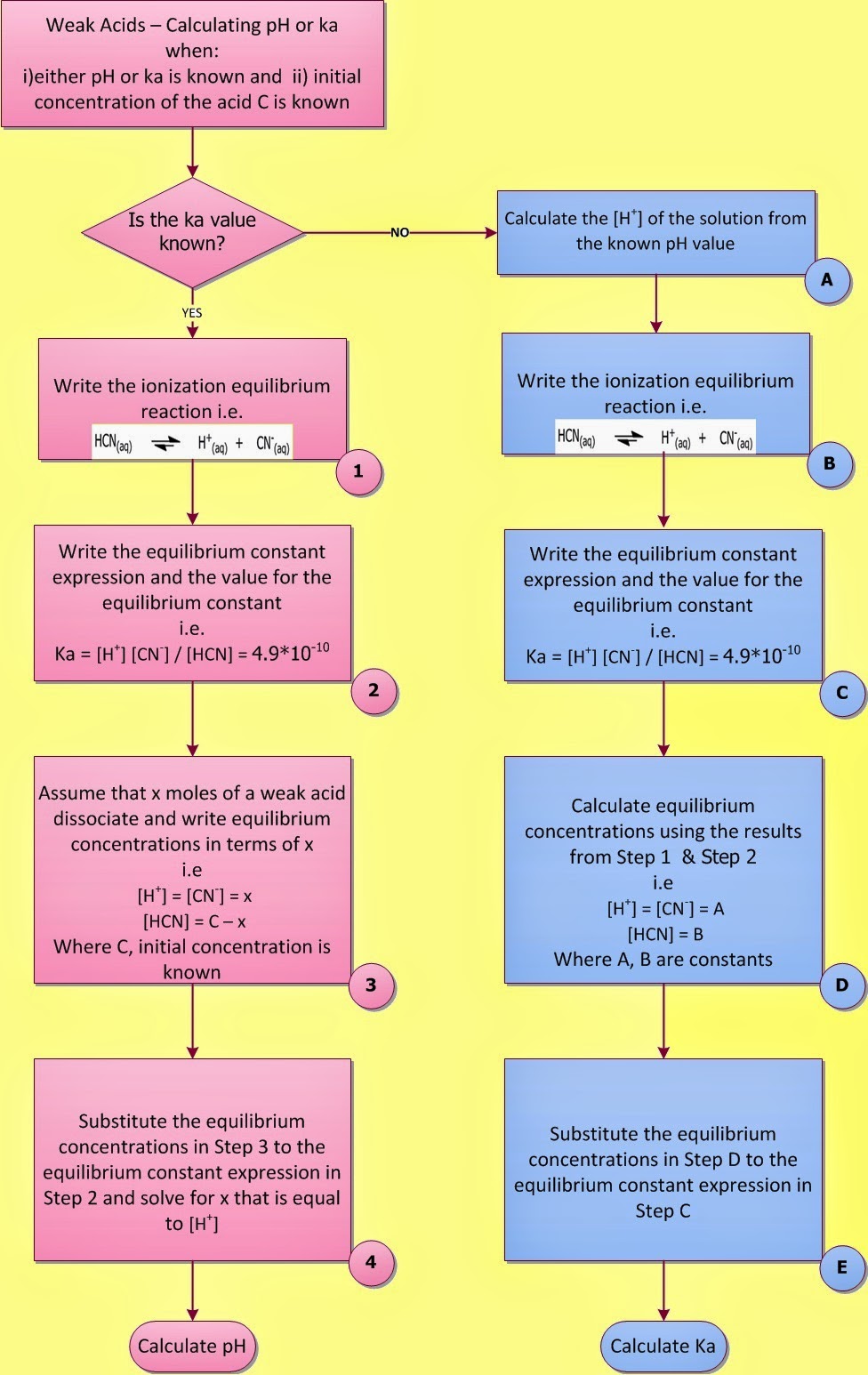
In a previous post entitled “Weak Acids and Bases – Calculate the pH of a weak acid” a general equation was derived for a weak acid base pH calculation (mathematical approach). A four-step method was also proposed for weak electrolyte pH calculation (calculate the pH for a weak acid - calculate the pH for a weak base, chemical approach) (Fig. I.1).
Solved examples using the above four-step method were presented in the post “Solving Weak Acid and Weak Base pH problems”
Some extra solved examples on weak acid (base) chemistry are shown below. The “chemical approach” method is used for the solution. 


Fig. I.1: Flowchart regarding the calculation of pH of a weak acid
Fig. I.1: Flowchart showing how to calculate the pH of a weak acid solution


Example I.1
Determine the pH of a 0.1 Μ weak acid HA solution (ka = 10-5). Suppose that 1 ml of this solution is added to a beaker that contains 99 ml of H2O to produce a new solution with total volume 100 ml. What is the pH value of the new solution?


DATA
[HA] = 0.1 M
ka = 10-5
VH2O = 99 ml
UNKNOWNS
a) pH = ?  b) (pH)NEW = ;   


Step 1: Write the ionization equilibrium reaction. The pH of a weak acid of known concentration has to be calculated
HA is a weak acid as the ka value shows. It dissociates partially in water according to equation (1):   dissociation of the weak acid HA 


Step 2: Write down the equilibrium constant expression and the equilibrium constant:
ka = [Η+] . [A-] / [HA] = 10-5       (2)


Step 3:   a) Let us suppose that x M of HA dissociate. Then the equilibrium concentrations of the species involved are as follows:
 
HA
Η+
Α-
Initial
0.1 Μ
0 Μ
0 Μ
Change
-x M
+x M
+x M
Final
(at equilibrium)
(0.1–x) M
x  M
x M


b) The moles of HA nHA in the new solution can be calculated as follows:
 1000 ml solution HA contains 0.1 moles «pure» ΗΑ
   1  ml  solution HA contains  y = ; moles «pure» ΗΑ        y = 10-4moles «pure» ΗΑ.
The concentration of ΗΑ in the new solution can be calculated as follows:
      100  ml HA contain      10-4moles «pure» ΗΑ      
    1000 ml  HA contain     y = ; moles «pure» ΗΑ              y = 10-3moles «pure» ΗΑ.
Therefore, the initial concentration of ΗΑ in the new solution is equal to:
[HA] = 10-3 M    (6)
From  (6) and similarly  to (α) the [Η+] concentration in the new solution can be calculated:
ka = (x). (x) /(0.001-x) = 10-5   and   x2 / 0.001 = 10-5    x = [H+] = 10-4M   (6)
Step 4:
a) From (2) and the equilibrium concentrations from the above table:
(x). (x) /(0.1-x) =  10-5    and     x2 / 0.1 = 10-5     and    x = 10-3 M   (3)
(0,1-x) ≈ x  since HA is a weak acid and dissociates slightly in water (as the ka shows).
The above assumption is valid since [HAdissociated]/ [HAinitial] * 100 = 1%  < 5%
Therefore [Η+] = [A-] = 10-3 M  (4)  and   pH = -log([H+]) = -log([10-3]) = 3
b) pH = -log([H+]) = -log([10-4]) = 4

The pH of the weak acid Ha is equal to 4 (concentration [HA] = 0.1 M)


Relevant Posts - Relevant Videos

References
  1. J.N. Butler  “Ionic Equilibrium – Solubility and pH calculations”, Wiley – Interscience, 1998
  2. J-L. Burgot “Ionic Equilibria in Analytical Chemistry”, Springer Science & Business Media, 2012
  3. D. Harvey,  “Modern Analytical Chemistry”, McGraw-Hill Companies Inc., 2000
  4. J.N. Spencer et al., “Chemistry structure and dynamics”, 5th Edition, John Wiley & Sons, Inc., 2012

Key Terms
weak acids and bases, calculate the pH of a weak acid, calculate the pH of a weak base, weak acid base chemistry

Strong Acids & Bases: pH Calculations involving mixtures of strong acids and bases

pH Calculations involving mixtures of strong acids and bases


Strong Acids & Bases: Calculations involving mixtures of strong acids and bases

Solutions containing two or more strong acids or two or more strong bases or a strong acid and a strong base are encountered very frequently in many practical applications of chemistry or in the chemical laboratory. In most cases like these chemistry intuition is needed to calculate the pH or pOH values of the solutions.
In previous posts entitled "Strong acid and bases - Weak acid and bases - Dissociation constants and pK's " and "Ionic Equilibrium - Strong Acids and Bases calculation of the pH of a strong acid. " the definition of strong acids and bases has been given. Strong acids and bases dissociate completely in water - and methods to calculate the pH of a strong acid or the pH of a strong base solution has been presented.
The following are the most commom strong acids and bases:
  • Salts and hydroxides of group I and II metals of the periodic table (ΝaOH, KOH, Ca(OH)2)
  • HCl, HBr, HI, HNO3, HClO3, HClO4 and Η2SO4 (1st dissociation)
Let us examine two examples where mixture of strong acids or strong acids and strong bases are given and the pH of their solution has to be calculated:


EXAMPLE #1


Solutions that contain two or more strong acids or bases with known initial concentrations C1,C2, C3,.. and the pH or pOH or [H+] or [OH-] are the unknowns and have to be calculated.The following 4-step method can be used:
  1. Write down the data given and the unknowns
  2. Write chemical reactions (dissociation reactions of the strong base or strong acid in this case ) and equations that relate data given and unknown (s) so that you have equal number of unknowns and equations
  3. Determine the total [H+]TOTAL = [H+] ACID 1+ [H+] ACID 2 + ... of the solution in equilibrium
  4. Calculate from the above steps pH, pOH, [H+] or [OH-]
Let us apply the above 4-step method in the following example:


Calculate the pH of a solution that was formed by mixing 10 ml 0.1 M HBr and 20 ml 0.1 Μ HCl

SOLUTION
STEP #1: Write down the data given and the unknowns:


STEP #2
: Write chemical reactions (dissociation reactions of the strong base or strong acid in this case ) and equations that relate data given and unknown(s) so that you have equal number of unknowns and equations
Equations that relate data given and unknowns are the following:

pH = -log [H+] (1)

In order to calculate the pH value in (1) we have to calculate [H+] in the solution after the mixing of the two solutions. The two strong acids completely dissociate to produce H+.
The volume V of the solution after mixing is found to be:

VFINAL = VHBr + VHCl = 10 ml + 20 ml = 30 ml (2)

HCl and ΗBr are strong acids and dissociate completely in water according to the following reactions:

The moles of «pure» ΗΒr dissolved in 10 ml 0.1M HBr solution is found to be:

Volume 1000 ml of ΗΒr solution contains 0.1 mol «pure» HBr
Volume 10 ml of ΗΒr solution contain x =; mol «pure» HBr
x = (0.1 mol HBr) * (10 ml) / 1000 ml = 10-3 mol HBr (5)

The moles of «pure» ΗCl in 20 ml 0.15M ΗCl solution is found tobe:
y = (0.1 mol HCl) * (20 ml) / 1000 ml = 2*10-3 mol HCl (6)

STEP #3: The [ΗBr]concentration after mixing - in the final solution with volume V= 30 ml - is found to be:
Volume 30 ml of the final solution contains 10-3 mol HBr
Volume 1000 ml of the final solution contain z =;
z = 3.3 * 10-2 mol/L HBr (7)

The [ΗCl] concentration in the final solution - after mixing the two acidic solutions - with volume V = 30 ml is found to be:
Volume 30 ml of the final solution contain 2*10-3 mol HCl
Volume 1000 ml of the final solution contain n =;
n = 6.6 * 10-2 mol/ℓ HCl (8)
From (7)+(8) and since HCl and ΗBr are strong acids and dissociate completely in water:
[H+] = 3.3 * 10-2 mol/L +6.6 * 10-2 mol/L = 9.9 * 10-2 mol/L ≈ 0.1M(9)

STEP #4: From (1)+(9): pH = -log [H+] = -log (0.1) ≈ 1


EXAMPLE #2

What is the pH value of a solution that is prepared by mixing 100 cm3 of 0.03 M HCl and 100 cm3 of 0.01 M NaOH.The total volume remains constant during the process.
SOLUTION

STEP #1: Write down the data given and the unknowns:


STEP #2: Write chemical reactions(the acid-base neutralization reaction in this case ) and equations that relate data given and unknown(s) so that you have equal number of unknowns and equations:

pH = -log [H+] (1)

After mixing the total volume of the solution is equal to Vtotal:
Vtotal = VHCl + VNaOH =100 cm3 + 100 cm3 = 200 cm3 (2)


The moles of "pure" HCl in the final solution can be calculated as follows:
Volume V =1000 cm3 of HCl solution contains 0.03 moles "pure" HCl
Volume V = 100cm3 of HCl solution contains a1 = ? moles "pure" HCl
a1 = 3 * 10-3 mol HCl
The concentration of [HCl] in the final solution is found to be:
Volume Vtotal= 200 cm3 of the final solution contains 0.03 moles "pure" HCl
Volume Vtotal= 1000 cm3 of the final solution contains a2 = ? moles"pure" HCl
a2= [HCl] = 0,015 mol (3)
Similarily, it can be shown that the concentration of NaOH in the final solution is equal to:
[ΝaOH] = 0,005 M (4)

The neutralization reaction that takes place and the equilibrium concentrations of the species involved after reaction is shown below:

STEP#3: The concentrations of the species involved at equilibrium are: [HCl]= 0.01 M and [NaCl] = 0.005 M. The pH of the solution is not affected by the ionization of NaCl. The strong acid HCl dissociates completely according to reaction (3) in the previous example to produce 0.01 M H+ and 0.01 MCl-.
Therefore: [H+] = 0.01 M(6)

STEP #4: From (1) + (6): pH = -log [H+] = -log (0.01) = 2


Relevant Posts

Strong Acids and Bases – Ionic Equilibrium – A general relation for the pH of a strong acid

Chemical Equilibrium Calculations in Analytical Chemistry

Acid and base strengths

pH of a strong acid – Examples


References

J-L. Burgot “Ionic Equilibria in Analytical Chemistry”, Springer Science & Business Media, 2012
J.N. Butler “Ionic Equilibrium – Solubility and pH calculations”, Wiley – Interscience, 1998
Clayden, Greeves, Waren and Wothers “Organic Chemistry”,Oxford,
D. Harvey, “Modern Analytical Chemistry”, McGraw-Hill Companies Inc., 2000

Key Terms

strong acids and strong bases, ph of mixture of strong acid and strong base, calculate pH of a mixture of strong acid and strong base, pH of mixture of strong acids, solutions that contain two or more strong acids or bases, mixture of strong acid and strong base

Polyprotic Acids / pH Calculation


Polyprotic Acids / pH Calculation


A large number of acids can give two or more protons on ionization (dissociation) and these are referred to as polyprotic acids. For example, with sulfurous acid (H2SO3) we have the successive ionizations:

Fig. I.1: Stepwise dissociation of sulphurous acid (H2SO3)

Fig. I.1: Stepwise dissociation of sulphurous acid (H2SO3)

A polyprotic acid always dissociates in a stepwise manner, one proton at a time. Note that the acid dissociation constants are labelled ka1 and ka2. The numbers on the constants refer to the particular proton of the acid that is ionizing. Thus, ka1 always refers to the equilibrium involving removal of the first proton of a polyprotic acid. Note also that ka2 for sulfurous acid is much smaller than ka1. This can be explained by the fact that the second H+ has to leave from a negatively charged species, HSO3- - electrostatic attraction has to be overcomed – while the first H+ from a neutral compound H2SO3.

The above observation is general: It is always easier to remove the first proton from a polyprotic acid than to remove the second and so on. The ka values become successively smaller as successive protons are removed.

The acid dissociation constants for common polyprotic acids are given in Table I.1
Table I.1: Stepwise dissociation constants for several common polyprotic acids

Table I.1: Stepwise dissociation constants for several common polyprotic acids


Polyprotic Acids and Ionic Equilibria  


Depending on the pH of the solution, a polyprotic acid may exist predominantly as the undissociated acid or any one of its anionic forms. It is easy to calculate the fraction present of the species involved in the equilibrium as a function of [H+].
 As an example let us calculate the fraction of phosphoric acid present as a function of the pH. Phosphoric acid is typical of most weak polyprotic acids in that its successive ka values are very different.

 
Stepwise dissociation of phosphoric acid
Fig. I.1: Stepwise dissociation of phosphoric acid