This chemistry blog is aimed mainly at senior high school students or first year university students. It covers general chemistry topics required in Colleges and Universities. However, chemistry topics of general interest are going to be included.
Chemical kinetics is the area of chemistry concerned with the rates (speeds) of reactions. It explains how the rates of different chemical reactions vary over an enormous range of time scales (seconds to years). The main goals of chemical kinetics is to understand the following:
The factors that control reaction rates
Establish relationships between the rate of a reactions and the amount of reactants present
Understand the steps by which a reaction occurs (mechanism of reaction)
Optimize conditions to carry out chemical reactions at reasonable rates under proper control
References
P. Atkins, J de Paula, “Physical Chemistry: Thermodynamics, Structure and Change”, 10th Edition, W. H. Freeman, 2014
D. A. McQuarrie, J. D. Simon,“Physical Chemistry: A Molecular Approach”, 1st Edition, University Science Books, 1997
K. J. Laidler, J.H. Meiser, B.C. Sanctuary, “Physical Chemistry”, 4th Edition, Brooks Cole, 2002
How to determine the order of a reaction by the initial rates method?
A rate law is an expression which shows how the rate of a reaction depends on the concentrations of reactants. For the decomposition of NO2 we can write:
2NO2(g) → 2NO(g) + O2(g)
Rate = k [NO2]n (Rate Law)
k is the rate constant
and n is the order of reaction (n can be positive or negative, integer or fraction)
Both k and n must be determined experimentally.
For the general reaction:
aA + bB → cC + dD (1)
the rate law is given by: Rate = k. [A]m [B]n (2)
There are two types of rate laws:
The differential rate law shows how the rate of a reaction depends on concentrations
The integrated rate law shows how the concentrations of species in the reaction depend on time
The first step in understanding how a given chemical reaction occurs is to determine the form of the rate law. In this post we will show ways to obtain the differential rate law of a reaction.
The rate law - in its general form - for most reactions is given by equation 1. Therefore, the task of determining the rate law becomes one of determining the reaction order m and n.
In most cases the reaction orders are:
Reaction order 0 in a reactant A (zero order reaction) ⇒ we write [A]0 ⇒changing the concentration of [A] the reaction rate R1 is not affected
Reaction order 1 in a reactant A (first order reaction) ⇒ we write [A]1 ⇒changing the concentration of [A] the reaction rate R1 is affected proportionally (doubling [A] will double the rate R2 = 2* R1)
Reaction order 2 in a reactant A (second order reaction) ⇒ we write [A]2 ⇒ doubling the concentration of [A] the reaction rate R1 is affected by a factor 22 (doubling [A] will affect the rate R2 = 4* R1) – tripling [A] the reaction rate R1 is affected by a factor 32 and becomes R3 = 9* R1)
N.B. Reaction rate depend on concentration but the rate constant k does not. The rate constant k is mainly affected by temperature and by the presence of a catalyst.
Example I.1
The initial rate of a chemical reaction A + B → C + D was measured for several different initial concentrations of A and B and the results are shown in Table I.1:
Experiment #
[A] (M)
[B] (M)
Initial Rate (M/s)
1
0.100
0.100
2.0*10-5
2
0.100
0.200
2.0*10-5
3
0.200
0.100
8.0*10-5
Using the data in Table I.1 determine: a) the rate law for the reaction b) the rate constant
a) The general form of the rate law for the reaction given is the following:
R = Rate = k * [A]m * [B]n
We must determine the reaction orders m and n using the experimental data given in Table I.1.
By comparing experiments #1 and #2 we see that while the concentration of [A] remains constant the concentration of [B] is doubled but the reaction rate remains constant. Therefore, [B] does not affect the rate of reaction and that means n=0.
By comparing experiments #1 and #3 we see that while the concentration of [B] remains constant the concentration of [A] is doubled and the reaction rate increases fourfold. This indicates that the rate is proportional to [A]2.
From the above two observations the rate law for the reaction is given by the expression:
R = Rate = k * [A]2 * [B]0 = = k * [A]2 (3)
b) Using data from Experiment #1 (or from #2 or #3) and from equation (3):
k = R / [A]2 = 2.0*10-5 / (10-1)2 = 2.0*10-3 M-1s-1
Rates of Chemical Reactions and the Collision Model
Reaction rates are affected both by reactant concentrations and by temperature. The collision model, that is based on the kinetic-molecular theory, explains for both of these effects at the molecular level. In general only a small number of reactant collisions leads to products (in certain cases 1 in 1013 collisions).
The basic principles of the collision model (collision theory) are as follows:
Molecules must collide to react – Collisions are necessary to transfer kinetic energy, to break reactant chemical bonds and form product bonds
The greater the number of collisions per second the greater the reaction rate – This agrees with the observation that as reactant concentration increases the rate of a reaction increases since the number of collisions increases. It also agrees with the observation that as temperature increases molecular velocities also are increased and therefore collision frequency and reaction rate is increased
Proper orientation of colliding molecules is essential for a reaction to occur – In most reactions, molecules must be oriented in a certain way during collision for a reaction to occur. The relative orientation of the molecules during collision facilitates bond formation between certain atoms (Fig I.1 and Fig. I.2)
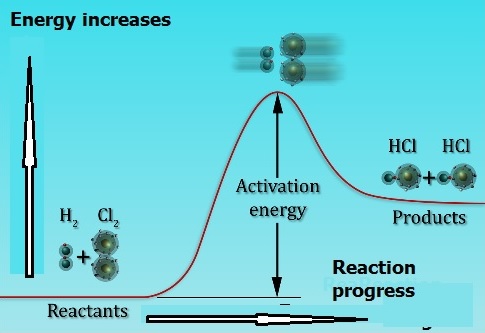
Molecules must collide with enough energy (activation energy) for a reaction to occur – Upon collision the kinetic energy of the molecules is used to stretch, bend and finally break bonds leading to chemical reactions. Svante Arrhenius suggested that molecules must posses a minimum amount of energy for the reaction to occur that is called activation energy.
Rate of reaction = (number of collisions per unit time) * (fraction of reactants with sufficient energy) * (fraction of reactants with proper orientation)
The four above collision model principles are incorporated into the Arrhenius equation:
k = A * e-(Ea/RT) (Arrhenius equation) (1)
Where, k is the reaction rate constant
Ea is the activation energy
R is the gas constant (8.314 J/mol.K)
and T is the absolute temperature
A is the frequency factor, a constant related to the frequency of collisions and the probability that the collisions are favorably oriented
As the activation energy of a reaction increases the reaction rate constant k decreases because the fraction of the molecules that possess the required energy is smaller.
Determination of Activation Energy and the Arrhenius Equation
Using a Graph:
The activation energy Ea of a reaction can be calculated by taking the natural logarithm ln at both sides of the Arrhenius equation:
k = A * e-Ea/RT and lnk = ln(A * e-Ea/RT) and lnk = ln(A * e-Ea/RT) = lnA – Ea/RT
lnk = – Ea/RT + lnA (2)
y = mx + b (3)
Equation (2) has the form of the equation of a straight line (3). Therefore, a plot of lnk versus 1/T is a straight line with a slope m = – Ea/RT
The activation energy of the reaction can be determined experimentally by measuring k at a series of temperatures, plotting a graph of lnk versus 1/T and calculating Ea from the slope of the line.
Using a Non-Graphical method:
Equation (2) can also be used to calculate Ea if we know the rate constant of a reaction at two different temperatures.
Let us see the following example:
Example I.1
The rate constant of a reaction is k=2.52*10-5 at a temperature 189.7 °C. When the reaction temperature is 251.2 °C the rate constant of the reaction is k=3.16*10-3. Determine the activation energy Ea of the reaction.
By applying equation (2) twice at the following temperatures:
T1 = 273.15 + 189.7 = 462.85 K k1=2.52*10-5
T2 = 273.15 + 251.2 =524.35 K k2=3.16*10-3
lnk = – Ea/RT + lnA (2)
lnk1 = – Ea/RT1 (4) and
lnk2 = – Ea/RT2 (5)
By subtracting and rearranging (4) and (5) we get:
k1 = – Ea/RT1 (4) and
ln k1 / k2 = (Ea/R)(1/T2 – 1/T1) and
ln (2.52*10-5)/( 3.16*10-3) = (Ea/[8.314) * (1/524.35 – 1/462.85)] and
ln (2.52*10-5)/( 3.16*10-3) = [(Ea/8.314) * (-2.5*10-4)] and
ln (2.52*10-5)/( 3.16*10-3)] = [(-2.5*10-4) *Ea / 8.314] and
Home > Rate of a Chemical Reaction - Chemical Kinetics
Rate of a Chemical Reaction - Chemical Kinetics
Chemical kinetics is the area of chemistry in which reaction rates are studied. Kinetics is largely an experimental science.
Reaction rate is called the speed at which a chemical reaction occurs.
Some chemical reactions are complete within a fraction of a second (explosions) while others take years (corrosion of metals) or even centuries (formation of mineral’s in Earth).
The basic concepts covered in this post are the following:
Factors that affect the rate of chemical reactions
Definition of the rate of reaction
What are the factors that affect the rate of chemical reactions?
Four factors allows us to change the rate at which a reaction occurs:
Physical state and nature of the reactants
Reactants in the same physical state tend to react faster since there is a greater chance for collision. Most of the reactions we consider are homogeneous involving either all gases or all liquids
Reactants in different physical states tend to react slower since there is a smaller chance for collision
Gases and liquids react faster than solids because of the increase in surface area.
Large and complex molecules tend to react slower than small molecules since the reaction site may be hindered and therefore statistically there is smaller chance for collision at it.
Reaction temperature
Reaction rates generally increase with temperature (Fig. I.1). Increasing temperature increases the kinetic energies of molecules. The higher the temperature, the higher the kinetic energies of the molecules and the greater the number of collisions.
Reactant Concentrations
The higher the concentration of reactants, the greater the chance of collision and the greater the reaction rate. For gaseous reactants, the pressure is directly related to the concentration. The greater the pressure the greater the reaction rate.
Catalysts
Catalysts increase reaction rates and are (theoretically) recoverable at the end of the reaction. Catalysts accomplish this by reducing the energy required for the reaction (activation energy)
Speed of a chemical reaction— reaction rate— is the change in the concentration of reactants or products per unit of time. The units for reaction rate are usually expressed as Molarity per second (M/s) —that is, the change in concentration measured in Molarity divided by a time interval measured in seconds.
Let us consider the general reaction:
A + 2B → C + 3D
The average rate of reaction can be expressed as:
Average rate of disappearance of A: - Δ[Α] / Δt
Average rate of disappearance of B: -(1/2) * Δ[B] / Δt
Average rate of appearance of C: + Δ[C] / Δt
Average rate of appearance of D: + (1/3) * Δ[D] / Δt
The first two expressions for the reactants are negative, because their concentrations will decrease with time
Where Δ[Α] Δ[B] Δ[C] and Δ[D] is the concentration change of A,B,C and D (Molarity) with time (s).