This chemistry blog is aimed mainly at senior high school students or first year university students. It covers general chemistry topics required in Colleges and Universities. However, chemistry topics of general interest are going to be included.
Electrochemistry is the study of the relationship between electricity and chemical reactions. It is primarily concerned with two processes that involve oxidation-reduction reactions:
the generation of an electric current from a chemical reaction and the opposite process,
the use of a current to produce chemical change.
At the heart of electrochemistry are the oxidation-reduction reactions. These reactions power batteries that in turn are used in cars, calculators, laptops and in our portable electronic gadgets.
Oxidation is the loss of electrons in a chemical reaction and reduction is the gain of electrons. Oxidation-reduction reactions occur when electrons are tranferred from an atom that is oxidized to an atom that is reduced. Redox reactions are involved not only in the operation of batteries but also in a wide variety of natural processes such as the rusting of iron, the respiration of animals and the browning of foods.
Several introductory topics of electrochemistry are going to be presented here. A list of topics is given in the table above.
References
D. Harvey, “Modern Analytical Chemistry”, McGraw-Hill Companies Inc., (2000)
P. Atkins, J. de Paula, “Physical Chemistry”, 9th Edition, W. H. Freeman (2009)
I. N. Levine, “Physical Chemistry”, 6th Edition, McGraw-Hill (2008)
Balancing Oxidation - Reduction reactions by the Oxidation Number
In many important chemical reactions, electrons are transferred from atom to atom. Such reactions are called either oxidation – reduction reactions or redox reactions. Many important chemical reactions involve oxidation and reduction. In a previous post entitled “Oxidation – Reduction (Redox) Reactions – Balancing Redox Reactions” several examples of redox reactions were given and the concept of oxidation number was discussed. Solved examples for the determination of oxidation numbers to atoms in chemical compounds were given in the post “Oxidation Numbers: Assigning oxidation numbers to atoms in a chemical compound – Examples”.
A number of different techniques have traditionally been taught in beginning chemistry students for balancing chemical reactions. These methods are the following:
Inspection: Most students of chemistry are taught to balance simple chemical reactions by “inspection”. Each student develops his or her own personal method based on practice. However, it becomes insufficient when relatively complex redox reactions have to be balanced.
Oxidation Number Method: This is another approach for balancing redox reactions. Oxidation numbers are assigned to atoms oxidized and reduced. By applying the general rule that the change in oxidation must be equal to the change in reduction, coefficients for these species are obtained, after which those of the remaining reactants and products.
Half-Reaction Method: The net reaction is divided into two half-reactions, one for oxidation and the other for reduction. These half reactions are balanced separately, then combined to form a balanced reaction.
Algebraic Method: The unbalanced chemical equation is used to define a system of linear equations, which can then be solved to yield the stoichiometric coefficients.
The oxidation number method is going to be presented in this post. The oxidation number method uses the fact that the amount of oxidation must equal the amount of reduction in the total chemical reaction. The basic steps are the following:
Step 1: Write the correct molecular formula for each reactant and product
Step 2: Identify the elements that change oxidation number during the reaction. Write the oxidation numbers of these atoms above the appropriate chemical symbols on both sides of the equation.
Step 3: Calculate the increase or decrease in the oxidation number per atom and for the entire molecule / ion in which it occurs. If these are not equal then multiply by suitable number so that these become equal.
Step 4: Balance the other metal ions that do not change oxidation number
Step 5: Add H+ (in acidic solutions) or OH- ions (in alkaline solutions) to the reaction on the appropriate side so that the total ionic charges of reactants and products are equal.
Step 6: Make the numbers of hydrogen atoms in the expression on the two sides equal by adding H2O molecules to the reactants or products. Similarily, balance the O atoms.
Let us apply the above in the following example:
Example I.1
Balance the following reaction:
ΗCl + K2Cr2O7 → KCl + CrCl3 + Cl2
Step 1: Write the correct molecular formula for each reactant and product.
The correct molecular formulas are given in this case
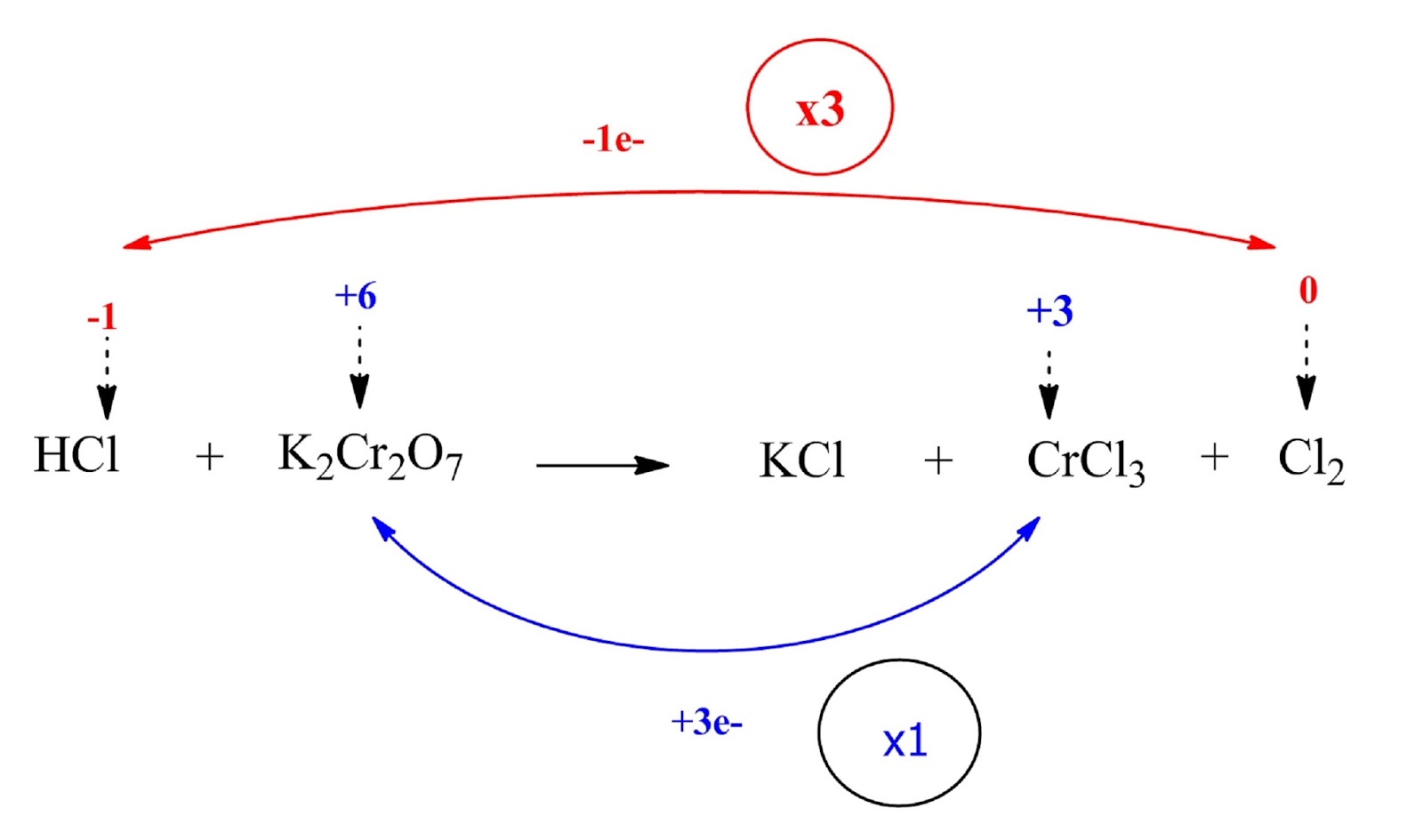
Step 2: Identify the elements that change oxidation number during the reaction. Write the oxidation numbers of these atoms above the appropriate chemical symbols on both sides of the equation.
The Cl ion is oxidized (the oxidation number increases from -1 to 0) while the Cr ion is reduced (the oxidation number decreases from +6 to +3).
Step 3: Calculate the increase or decrease in the oxidation number per atom and for the entire molecule / ion in which it occurs. If these are not equal then multiply by suitable number so that these become equal.
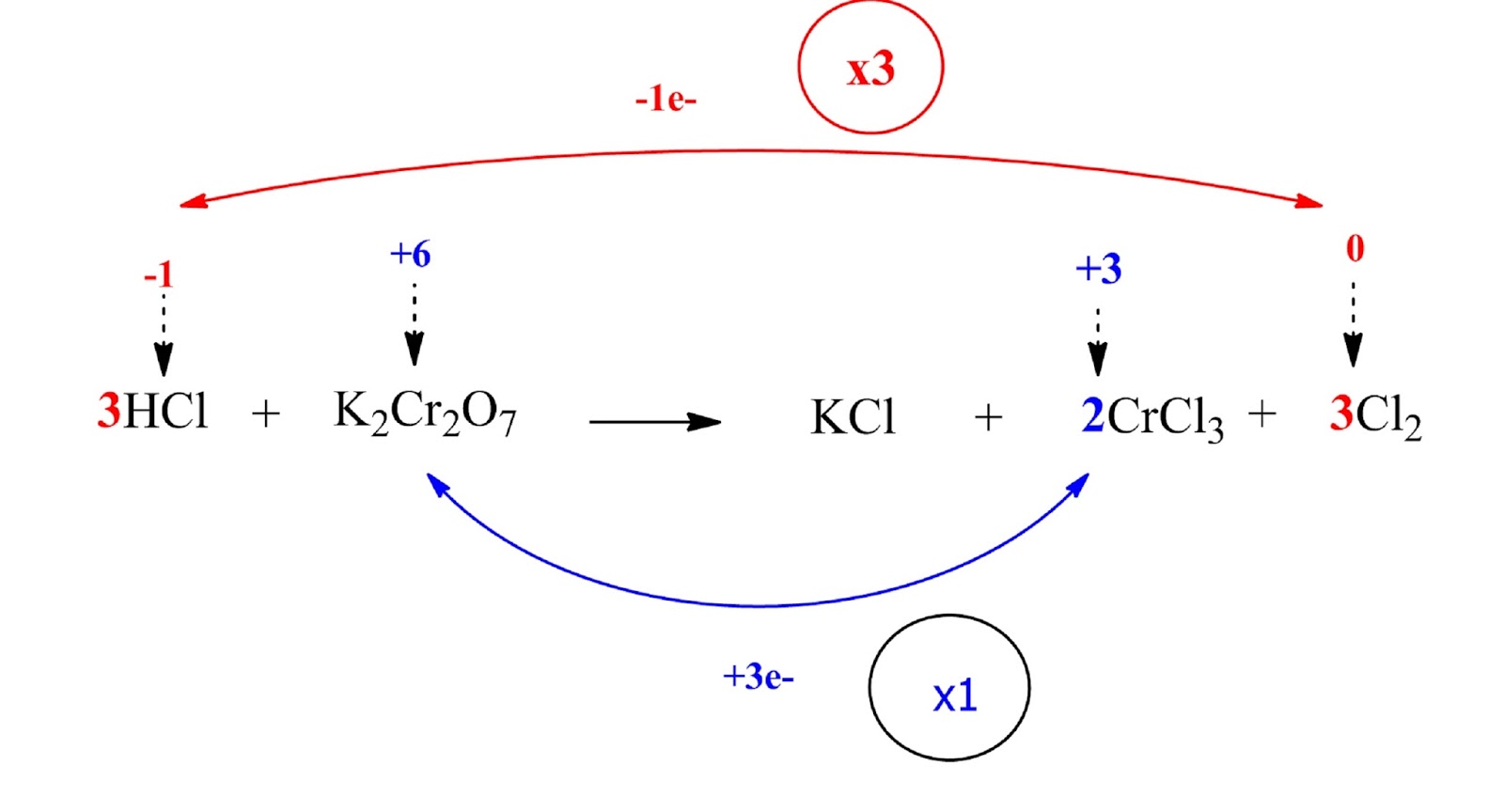
HCl and Cl2 are multiplied by 3 (coefficient 3) while K2Cr2O7 and Cl2 by 1 (coefficient 1).
Step 4: Balance the ions that do not change oxidation number
The K atoms in our case (their oxidation number remains constant)
Step 5: Add H+ (in acidic solutions) or OH- ions (in alkaline solutions) to the reaction on the appropriate side so that the total ionic charges of reactants and products are equal.
The reaction is in acidic solution (HCl). HCl must be added on the reactants side to balance the 14 Cl atoms on the product’s side. Therefore the coefficient of HCl is going to be 14.
Step 6: Make the numbers of hydrogen atoms in the expression on the two sides equal by adding H2O molecules to the reactants or products. Similarily, balance the O atoms.
Since there are 14 H’s on the left-hand side we have to add 7H2O on the right-hand side to balance them. The reaction is now properly balanced.
Oxidation / Reduction<meta name="description" content="In many important chemical reactions, electrons are transferred from atom to atom. Such reactions are called either oxidation – reduction reactions or redox reactions. Examples for calculating oxidation numbers of atoms in molecules or ions are given">
<meta name="keywords" content="oxidation, reduction, redox, oxidation number, solved examples on oxidation numbers, oxidation number calculator,oxidation numbers list,oxidation numbers rules,oxygen oxidation number,oxidation number of iodine,how to find oxidation number,oxidation state rules mcat,how to assign oxidation numbers in redox reactions,">
Oxidation Numbers: Assigning oxidation numbers to atoms in chemical compounds - Examples
In a previous post entitled “Oxidation – Reduction (Redox) Reactions – Balancing Redox Reactions” the general steps for assigning oxidation numbers to atoms in a molecule or ion were presented. Assignment of oxidation numbers is a basic step for balancing redox reactions.
A few solved examples are given below:
Example #1
Calculate the oxidation number of the S atom in the following compounds: α) H2S b) SO4-2
α)
Step 1: Find the most electronegative atom
The most electronegative atom in H2S is the S atom
Step 2: The oxidation number of the most electronegative atom is equal to the charge of its ion
Since the charge of sulfur’s ion is unknown let’s suppose that is equal to x
Step 3: Oxidation numbers that are not known have to be calculated.
The oxidation number of H2S when it bonds to nonmetals (like S) is +1.
Since H2S is neutral the sum of the oxidation numbers must be equal to 0
H2S
(+1) * 2 + x = 0
2 + x = 0 and therefore x=oxidation number of S = -2
Therefore the oxidation number of S in H2S is equal to -2
b)
Step 1: Find the most electronegative atom
The most electronegative atom in SO4-2 is the O atom
Step 2: The oxidation number of the most electronegative atom is equal to the charge of its ion
The charge of oxygen ion is -2 in covalent compounds
Step 3: Oxidation numbers that are not known have to be calculated.
Since SO4-2 has a charge of -2 the sum of the oxidation numbers of the atoms of SO4-2 must be equal to -2. Let us suppose that the oxidation number of S is equal to x.
SO4-2
x+ 4 * (-2) = -2
x – 8 = -2 and therefore x = +6
Therefore, the oxidation number of S in SO4-2 is +6.
The above two examples show that an element can have more than one oxidation number (oxidation state) depending upon the other elements to which is attached.
Example #2
Calculate the oxidation number of the elements: a) propane C3H8 and b) S4O6-2
a)
Step 1: Find the most electronegative atom
The most electronegative atom in C3H8 is the C atom
Step 2: The oxidation number of the most electronegative atom is equal to the charge of its ion
The oxidation number of oxygen x is unknown and it has to be calculated. The oxidation number of hydrogen is +1 in covalent compounds.
Step 3: Oxidation numbers that are not known have to be calculated.
C3H8
(3 * x) + (8 * 1) = 3x + 8 = 0
⇒ x = -8/3
Therefore, the oxidation number of C in C3H8 is -8/3.
b)
Step 1: Find the most electronegative atom
The most electronegative atom in S4O6-2 is the O atom
Step 2: The oxidation number of the most electronegative atom is equal to the charge of its ion
The oxidation number of oxygen is equal to -2 in covalent compounds. Let us suppose that x is the oxidation number of the S atom
Step 3: Oxidation numbers that are not known have to be calculated.
S4O6-2
(4 * x) + (6 * (-2)) = -2
⇒ 4x - 12 = -2
⇒ 4x = 10 ⇒ x = +5/2
Therefore, the oxidation number of S in S4O6-2 is equal to +5/2
Oxidation / Reduction<meta name="description" content="In many important chemical reactions, electrons are transferred from atom to atom. Such reactions are called either oxidation – reduction reactions or redox reactions.
Many important chemical reactions involve oxidation and reduction. In fact, most reactions used for energy production are redox reactions. In living species the oxidation of sugars, fats, and proteins provides the energy necessary for life. The electric current from the batteries that power computers and cell phones is generated by oxidation-reduction reactions. Three definitions for redox reactions are given. Oxidation number is defined. Method for calculating oxidation numbers">
<meta name="keywords" content="oxidation, reduction, redox, definition of oxidation and reduction, oxidation number, calculation of oxidation numbers, loss of electrons, gain of electrons, balancing redox reactions,balance redox reactions calculator, balancing redox reactions examples, balancing redox reactions worksheet,balancing redox reactions: oxidation number method,balancing redox reactions: half reaction method, balancing redox reactions practice, balancing redox reactions in basic solution, balancing redox reactions in acidic solution">
reactions - Balancing redox reactions
Redox Reactions – Balancing Redox Reactions
In many important chemical reactions, electrons are transferred from atom to atom. Such reactions are called either oxidation – reduction reactions or redox reactions.
Many important chemical reactions involve oxidation and reduction. In fact, most reactions used for energy production are redox reactions. In living species the oxidation of sugars, fats, and proteins provides the energy necessary for life. The electric current from the batteries that power computers and cell phones is generated by oxidation-reduction reactions.
One of the most familiar redox reactions is corrosion of a metal. Corrosion is the conversion of a metal into a metal compound by a reaction between the metal and some substance in its environment. When a metal corrodes, each metal atom loses electrons and a cation is formed, which can combine with an anion to form an ionic compound.
The bright metallic surface of calcium tarnishes as CaO forms:
2Ca (s) + O2 (g) → 2 CaO (s)
In the above reaction Ca is oxidized to Ca+2 and O2 which is neutral becomes O-2 is reduced.
As a matter of fact the old definition for oxidation and reduction was:
Oxidation is the reaction of an element with oxygen (O2) to form an oxygen-containing compound and reduction is the removal of oxygen from a compound
For example:
C + O2 → CO2 (oxidation, combined with O)
ZnO + C → Zn + CO (reduction, loss of O)
Also,
Oxidation is called the removal of hydrogen from a compound and reduction the reaction with (H2) to form a hydrogen-containing compound
In all the above (redox reactions) where an element reacts with O2 or H2, there is some kind of electron transfer from one atom to another. The fact, that the first redox reactions studied by chemists were reactions with O2, gave the name oxidation to this process.
However, there are other reactions where electron(-s) are transferred –the reaction is a redox - but there is no O2 or H2 in the reactants or in the products (Fig. I.2).
For example,
A more general definition for oxidation and reduction was proposed to include reactions like one shown in Fig. I.2 where O2 or H2 is not a reactant or product.
Oxidation is called the loss of electrons by an element or compound
Reduction is called the gain of electrons by an element or compound
There are though reactions where there is no complete transfer of electron(-s) from one element to another (as in the case of Na and Cl, Fig. I.2) but a partial transfer of electrons to the more electronegative element. Such a reaction is between Η2 and Br2 (Fig. I.1). The bond formed between H and Br atoms is a polar bond with a partial negative charge on Br atoms and a partial positive charge on H atoms (Fig. I.3)
Becauce the reaction of Na(s) and Cl(g) and that of H2(g) and Br2(g) are so much alike, chemists have expanded the definition of oxidation - reduction reactions to include partial as well as a complete transfer of electrons.
Oxidation is defined as the complete or partial loss of electrons by an element or compound
Reduction is defined as the complete or partial gain of electrons by an element or compound
The Na atom (Fig. I.2) when it reacts with Cl2 is oxidized to Na+ and the Cl atom is reduced. Because the Na atom makes it possible for the Cl atom to be reduced is called a reducing agent.
The Cl atom (Fig. I.2) when it reacts with Na is reduced to Cl-1. and the Na atom is oxidized. Because the Cl atom makes it possible for the Na atom to be oxidized is called an oxidizing agent.
However, by simply reading a chemical reaction does not always tell us whether oxidation or reduction has occurred. Chemists have developed a numerical system to help identify a reaction as redox. The first step in this system is to assign a number called oxidation number to each atom in the reaction. The concept of oxidation numbers (also called oxidation states) was devised as a way of keeping track of electrons gained by the substance being reduced and electrons lost by the substance being oxidized.
The general steps for assigning oxidation numbers to atoms in a molecule or ion are the following:
The oxidation number for each atom in a pure element is zero
The oxidation number of a monoatomic ion is equal to its charge
When H atoms are combined with nonmetals their oxidation number is +1 (i.e. ΗCl, NH3, H2O, CH4…). When H atoms are combined with metals their oxidation number is -1 (i.e. NaH)
The oxidation number of O is usually -2 (i.e. CO, CO2, SO2). The major exception is peroxides where its oxidation number is -1 (i.e. Η2Ο2) and OF2 where its oxidation number is +2
When fluorine atoms are combined with atoms of other elements, their oxidation number is -1
If a compound’s formula contains one element for which an oxidation number cannot be assigned using the above steps, the oxidation number is calculated as follows:
The sum of the oxidation numbers of all atoms in a neutral compound is zero.
The sum of the oxidation numbers for the atoms in a polyatomic ion is equal to the overall charge on the ion
By using the concept of oxidation number a new definition for oxidation and reduction was proposed:
Oxidation is a reaction where an increase in the oxidation number of an element occurs
Reduction is a reaction where a decrease in the oxidation number of an element occurs
Example #1
Calculate the oxidation number of the atoms in: α) CO2 b) SF6
α)
Step 1: Find the most electronegative atom
The most electronegative atom in CO2 is the O atom
Step 2: The oxidation number of the most electronegative atom is equal to the charge of its ion
For O is O-2
and therefore the oxidation number is -2
Step 3: Oxidation numbers that are not known have to be calculated.
The oxidation number of C in CO2 is unknown and let us suppose that is x
Then since CO2 is neutral the sum of the oxidation numbers must be equal to 0
CO2
x + 2 * (-2) = x – 4 = 0
x = 4
Therefore the oxidation number of C in CO2 is equal to +4
b)
Step 1: Find the most electronegative atom
The most electronegative atom in SF6 is the F atom
Step 2: The oxidation number of the most electronegative atom is equal to the charge of its ion
For F is F-1 and therefore the oxidation number is -1
Step 3: Oxidation numbers that are not known have to be calculated.
The oxidation number of S in SF6 is unknown and let us suppose that is x
Then since SF6 is neutral the sum of the oxidation numbers must be equal to 0