Chemistry Net: Physical & Theoretical Chemistry - Lewis Structures
Showing posts with label Physical & Theoretical Chemistry - Lewis Structures. Show all posts

Lewis Structures of Sulfur Trioxide (SO3) & Electrostatic Potentials (ESP)

Lewis Structures of SO<sub>3</sub> & Electrostatic Potentials ESP

Lewis Electron Dot Structure of Sulfur Trioxide SO3 & Electrostatic Potentials ESP

A simple procedure for writing Lewis Structures was given in a previous article entitled Lewis Structures and the Octet Rule”. Several worked examples relevant to this procedure were given in previous posts please see the Sitemap - Table of Contents (Lewis Electron Dot Structures).

The Lewis Electron Dot Structures of SO3 were drawn using this procedure in a previous article entitled "Simple Procedure for writing Lewis Structures – Lewis Structures for sulfur trioxide SO3"

Lewis structures #1 - #4 are the derived resonance structures:
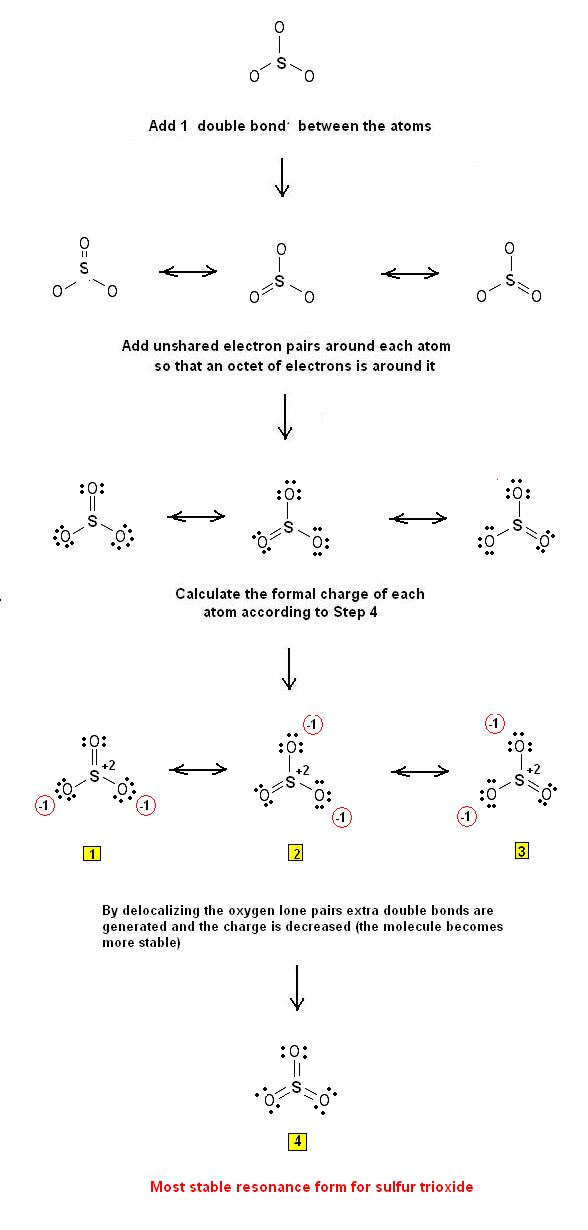
Figure I.2: Lewis structures for SO3. In this case the sulfur atom, using valency shell n =3 is not restricted to an octet, and additional double bonds may be generated from the oxygen lone pairs to equalize the charge. Resonance structure 4 is the most probable one since the there is no charge separation.


Molecular Orbital Theory and ab initio calculations can be used to calculate and draw the electrostatic potential (ESP) of a molecule.

The molecular electrostatic potential is the potential energy of a proton at a particular location near a molecule. There are negative and positive ESP's.

Negative electrostatic potential corresponds to a attraction of the proton by the concentrated electron density in the molecules (mainly from lone pairs, pi-bonds,... ) (colored red). Red color in electrostatic potential drawings show areas with high electron density.

Positive electrostatic potential corresponds to repulsion of the proton by the atomic nuclei in regions where low electron density exists and the nuclear charge is incompletely shielded (colored blue). Blue color in electrostatic potential drawings show areas with low electron density.

Several ab initio softwares calculate electrostatic potentials based on quantum mechanically derived molecular orbitals. The electrostatic potential of SO3 derived by ab initio calculations is shown below:

Figure I.3: Electrostatic Potential of SO3. Red-colored areas are electron-rich. Blue-colored areas are electron deficient. The electrostatic potential is in agreement with the Lewis structures of SO3 showing most of the electron density on the O atoms and most of the positive charge (electron deficient area) on the sulfur S atom

It is to be noted that most of the negative charge (electron rich areas, colored red) is concentrated on the oxygen atoms of SO3 as it is expected from the Lewis structures of SO3 and by chemical intuition. Most of the positive charge (electron deficient areas, colored blue) is concentrated on the S atom as it is expected from the Lewis structures of SO3 and by chemical intuition.


Relevant Posts

Lewis Structures|Octet Rule: A Simple Method to write Lewis Structures

Lewis structure of SO2 – Simple Procedure for drawing Dot structures

Lewis Dot Structure of the sulfite ion SO3-2


References

  1. G.N. Lewis, J.A.C.S, 38, 762-785, (1916)
  2.  E. C. McGoran, J. Chem. Educ., 68, 19-23 (1991)
  3. A.B.P. Lever, J. Chem. Educ., 49, 819-821, (1972)


Key Terms

resonance structures of sulfur trioxide SO3, Lewis electron structures of SO3, chemical formula of SO3, simple method for drawing Lewis structures of SO3, electrostatic potential, ab initio,molecular orbital theory

u>


Lewis Structures & the Octet Rule - Theory & Examples

Lewis Structures - Theory & Examples

LEWIS STRUCTURES AND THE OCTET RULE - THEORY & EXAMPLES
PO4-3, PO3-, HO4P-2
P2H2, POCl3, IO3-
CH2N2, CN2H2, N2H3+, N3-
SO2Cl, HSO3Cl, S2O6
C2O4-2, BrO3-, N5+
CH3NO2, CH2NH, C2-2
CH3COOCH3, CH3CONH2, C3H4
C3H5+, C3H3N, BF


Lewis structures constitute an overwhelming majority of the structures that students encounter in courses in general chemistry, organic chemistry, or biochemistry. Hence, the writing of Lewis structures corresponding to a given molecular formula is an important exercise for them. The ability of students to write these structures correctly and then to calculate the formal charges of the atoms involved, is a prerequisite to understanding such topics as:

  • Resonance
  • Reactivity
  • Acidity and basicity
  • Bond and molecular polarities
  • Inter- and intra-molecular bonding
  • Isomerism and molecular geometry.

Since many chemistry textbooks do not give easy procedures for writing such structures an easy four-step method is presented and several worked-examples are given(1-3).


References

  1. G.N. Lewis, J.A.C.S, 38, 762-785, (1916)
  2.  E. C. McGoran, J. Chem. Educ., 68, 19-23 (1991)
  3. A.B.P. Lever, J. Chem. Educ., 49, 819-821, (1972)

Help with Lewis electron dot structures | Chlorine Perchlorate Cl2O4

Lewis Electron Dot Structures - Simple Procedure for writing Lewis Structures of chlorine perchlorate (Cl2O4)

Simple Method for writing Lewis Electron Dot Structures

of chlorine perchlorate Cl2O4

A simple procedure for writing Lewis electron dot structures is given in a previous article entitled “Lewis Structures and the Octet Rule”. Several worked examples relevant to this procedure were given in previous posts please see the Sitemap - Table of Contents (Lewis Electron Dot Structures).

Another example  for writing Lewis structures following the above procedure is given below.

How can we construct the Lewis structure of Cl2O4?


Step 1: Connect the atoms with single bonds.

 Connect the atoms with single bonds

Step 2: Calculate the # of electrons in π bonds (multiple bonds) using  formula (1) in the article entitled “Lewis Structures and the Octet Rule”. 

Where n in this case is 6 since Cl2O4 consists of six atoms.

Where V = (6 + 7 + 6 * 2 + 6 + 7) = 38   

Therefore, P = 6n + 2 – V = 6 * 6 + 2 – 38 = 0

So there are no π electrons in Cl2O4 and therefore the structure of Step 1 is the Lewis structure.

Electrons are placed around each atom so that the octet rule is obeyed. Formal charges are assigned and equalized using resonance.


Step 3 & 4: The Lewis structures for Cl2O4 are derived below:

 Fig. 2 : Plausible Lewis structure of chlorine perchlorate.


Relevant Posts - Relevant Videos

Lewis Structures|Octet Rule: A Simple Method to write Lewis Structures

Simple Method for writing Lewis Structures of Perchloric Acid HClO4


References

  1. G.N. Lewis, J.A.C.S, 38, 762-785, (1916)
  2. E. C. McGoran, J. Chem. Educ., 68, 19-23 (1991)
  3. A.B.P. Lever, J. Chem. Educ., 49, 819-821, (1972)


Key Terms

resonance structures of chlorine perchlorate cl2o4, Lewis electron structures of chlorine perchlorate , chemical formula of chlorine perchlorate cl2o4, simple procedure for drawing Lewis structures of chlorine perchlorate,


Electron Dot Structures of peroxy nitric acid HO2NO2

Electron Dot Structures of peroxy nitric acid HO2NO2

Electron Dot Structures of peroxy nitric acid HO2NO2

A simple procedure for writing electron dot structures (Lewis structures) is given in a previous article entitled “Lewis Structures and the Octet Rule”. Several worked examples relevant to this procedure were given in previous posts please see the Sitemap - Table of Contents (Lewis Electron Dot Structures).

Another example  for writing Lewis structures following the above procedure is given below.

Let us consider the case of of peroxy nitic acid (HO2NO2) (known also as PAN HNO4).

Peroxynitric acid HNO4 plays an important role in the coupling of atmospheric HOx and NOx cycles4, especially at low temperatures. PNA serves as an important HOx and NOx reservoir species altering the oxidative capacity of the atmosphere on regional and global scales5. PNA is formed via the reaction of HO2 and NO2.


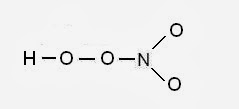
Step 1: Connect the atoms with single bonds.

The central atom will be the N atom since it is the less electronegative (H is a terminal atom – it cannot be a central atom).

  Fig. 1 : Connect the atoms of peroxy nitric acid with single bonds.

Step 2:

Calculate the # of electrons in π bonds (multiple bonds) using  formula (1) in the article entitled “Lewis Structures and the Octet Rule”. 

Where n in this case is 5 since HO2NO2 consists of six atoms but one of them is a H atom.

Where V = (1 + 6 + 6 + 5 + 6 + 6) = 30

Therefore, there are 2 π electrons in HO2NO2 and so 1 double bond must be added to the structure of Step 1.


Step 3 & 4: One double bond must therefore be placed through the 3 N-O bonds. Therefore, the Lewis electron dot structures for HO2NO2 are as follows:

Figure 2: Lewis structures of peroxy nitric acid

Stuctures #1 and #2 are the more plausible (more stable) due to smaller charge separation.


Relevant Posts - Relevant Videos

Lewis Structures|Octet Rule: A Simple Method to write Lewis Structures

Simple Method for writing Lewis Structures – Lewis Structures of CF3NO


References

  1. G.N. Lewis, J.A.C.S, 38, 762-785 (1916)
  2. E. C. McGoran, J. Chem. Educ., 68, 19-23 (1991)
  3. A.B.P. Lever, J. Chem. Educ., 49, 819-821 (1972)
  4. H. Niki et al., Chem. Phys. Lett., 45, 564-566 (1977)
  5. S. Kim et al., J. Geophys. Res.-Atmos., 112, D12S01 (2007)


Key Terms

resonance structures of HO2NO2 peroxy nitric acid , Lewis electron structures of , chemical formula of HO2NO2 peroxy nitric acid, simple procedure for drawing Lewis structures of PNA peroxy nitric acid,


Lewis dot of Nitrogen Monoxide (NO)

Lewis dot of Nitrogen Monoxide (NO)

Lewis dot of Nitrogen Monoxide (NO)

A simple procedure for writing Lewis Structures is given in a previous article entitled Lewis Structures and the Octet Rule. Several worked examples relevant to this procedure were given in previous posts please see the index page Lewis Structures & the Octet Rule - Theory & Examples.

Another example for writing Lewis structures following the above procedure is given in this post. The Lewis structures of Nitrogen Monoxide NO are drawn.

Let us consider the case of NO. NO is a free radical and is an important intermediate in the chemical industry. Nitric oxide is a by-product of combustion of substances as in automobile engines, fossil fuel power plants, and is produced naturally during the electrical discharges of lightning in thunderstorms. In mammals including humans, NO is an important cellular signaling molecule involved in many physiological and pathological processes. The vasodilating antihypertensive drug minoxidil contains an NO moiety and may act as an NO agonist. Likewise, Sildenafil citrate, popularly known by the trade name Viagra, stimulates erections primarily by enhancing signaling through the nitric oxide pathway in the penis.

Let us draw the Lewis dot structures of Nitrogen Monoxide (NO).

Step 1:   Connect the N with the O atom with single bonds

Fig. 1 : Connect the atoms of NO with single bonds

Step 2: Calculate the # of electrons in π bonds (pi bonds, multiple bonds) using formula (1) in the article entitled “Lewis Structures and the Octet Rule”. 


Where n in this case is 2 since NO consists of two atoms.


Where V = 5 +6  = 11 , V is the number of valence electrons of the ion.

Therefore, P = 6n + 2 – V = 6 * 2 + 2 – 11  = 3     So, there is 1 double bond and an electron.


Step 3 & 4: The  Lewis dot resonance structures of Nitrogen Monoxide (NO) are as follows:


Lewis dot resonance structures of nitrogen monoxide NO


Relevant Posts - Relevant Videos


References
  1. G.N. Lewis, J.A.C.S, 38, 762-785, (1916)
  2.  E. C. McGoran, J. Chem. Educ., 68, 19-23 (1991)
  3. A.B.P. Lever, J. Chem. Educ., 49, 819-821, (1972)

Key Terms
lewis structures of nitrogen monoxide NO, simple method for writing Lewis structures, valence electrons, single bonds, electrons in π bonds, resonance structures, electron dot structures of nitrogen monoxide NO