Chemistry Net: 10/01/2013 - 11/01/2013

The five major HPLC components and their functions

HPLC chromatography: The five major hplc components

The five major HPLC components and their functions

In a previous post entitled “What is Liquid Chromatography? What is HPLC (High Performance Liquid Chromatography)” the LC and the HPLC analytical techniques were introduced and the main advantages and disadvantages were explained.

The five major HPLC components and their functions are going to be presented in this post:


The Pump:

The role of the pump is to propel (force) a liquid (the mobile phase) through the chromatograph at a specific flow rate, expressed in ml/min. Normal flow rates in HPLC are 1-2 ml/min and typical pumps can reach pressures in the range of 2000 – 9000 psi but in applications covered under UHPLC mode operating pressure can be as high as 15000-18000 psi. The normal flow rate stability must be < 1%.


HPLC pump

An ideal pump should have the following characteristics:

  • Solvent compatibility and resistance to corrosion
  • Constant flow delivery independent of back pressure
  • Low dead volume for minimum problems on solvent changeover

The main types of pumps used in HPLC (or in LC) are the following:

  • Constant Pressure Pumps : Provide consistent continuous flow rate through the column with the use of pressure from a gas cylinder.
  • Constant Flow Pumps: a) Reciprocating Piston pumps deliver solvents through reciprocating motion of a piston in a hydraulic chamber. The main drawback of a reciprocating pump is that it produces a pulsing flow. With a flow-sensitive detector, such as micro-adsorption detector, a pulse damping system must be used and detector sensitivity is reduced. b) Syringe type pumps are suitable for small bore columns. Constant flow rate is delivered to column by a motorized screw arrangement.

The pump should be inert to solvents, buffer salts and solutes. They are made of stainless steel, titanium and resistant minerals.

There are two types of pump operation:

  • Isocratic pump -  delivers constant mobile phase composition
  • Gradient pump – delivers variable mobile phase composition


The Injector:

The sample should be introduced as a plug, without disturbing the column packing. The injector serves to introduce the liquid sample into the flow stream of the mobile phase. Typical sample volumes are 5-20 μL. The injector must be able to withstand the high pressure of the mobile phase. A precolumn, a small removable section of tubing containing the same packing material as the column, can be used ahead of the analytical column to protect the latter from contamination. The precolumn also acts as a buffer to prevent channeling of the packing during injection.


The Column:

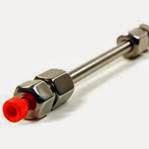
The column is considered the heart of the chromatograph. The success or failure of a particular analysis depends on the choice of column. The column’s stationary phase separates the sample components using various physical and chemical parameters.

There are four types of columns used in HPLC:

  • High performance analytical columns [internal diameter (i.d.) 1.0-4.6 mm; lengths 15 –250 mm] - used mainly for qualitative and quantitative analysis
  • Preparative columns (i.d. > 4.6 mm; lengths 50 –250 mm) – used mainly for preparative work
  • Capillary columns (i.d. 0.1 -1.0 mm; various lengths) 
  • Nano columns (i.d. < 0.1 mm)

HPLC column

The tubing used for the construction of columns can be:

  • Glass – mostly for biomolecules
  • Stainless steel – the most popular;  can withstand high pressures
  • PEEK polymer – chemically inert to most solvents and biocompatible

Columns are packed with small diameter porous particles. Usually the size of the porous materials used are 1,6 – 5 μm. The column packings used in liquid/solid chromatography (LC, HPLC) are silica gel, charcoal and alumina. Most users purchase pre-packed columns to use in their liquid chromatographs. These porous particles in the column usually have a chemically bonded phase on their surface which interacts with the sample components to separate them from one another – for example, C18 is a popular bonded phase. The process of retention of the sample components is determined by the choice of column packing and the selection of the mobile phase to push the analytes through the packed column.


The Detector:


The Gradient Device:


Relevant Posts

What is reversed phase liquid chromatography (LC) / HPLC?

Normal phase liquid chromatography (LC) / HPLC?

Which are the main liquid chromatography separation modes? / Liquid-Liquid Chromatography (LLC)

Selection of the Liquid Chromatographic (LC) / HPLC Separation Mode

Troubleshooting HPLC / Liquid Chromatography Systems – Peak Tailing


References
  1. Nina Hadden et al., “Basic Liquid Chromatography”, Varian Aerograph, 1971
  2. C.A. Dorschel, J.L. Ekmanis, J.E. Oberholtzer  et al. “LC Detectors” Anal. Chem., 61, 951A–968A, 1989
  3. C. F. Simpson, “Techniques in Liquid Chromatography” Wiley-Hayden: Chichester, England, 1982
  4. L.R. Snyder, J. L Glajch,  J. J. Kirkland, “Practical HPLC Method Development”, Wiley-Interscience: New York, 1988.
  5. V.R. Meyer, “Practical High – Performance Liquid Chromatography”, Wiley, 2010
  6. M. McMaster, “LC/MS A Practical User’s Guide”, Wiley-Interscience, 2005

Key Terms
HPLC, high performance liquid chromatography, pump, hplc column, injector, detector, capillary column, isocratic pump

What is Liquid Chromatography? What is HPLC (High Performance Liquid Chromatography)

What is Liquid Chromatography (LC)? What is HPLC (High Performance Liquid Chromatography)?


HPLC / Liquid Chromatography (LC)


History


Historically, chromatography dates back to a Russian chemist, Mikhail Tswett, who gave a lecture in 1903 on the separation of the pigments in green leaves on a chalk column. His first papers were actually published in 1906. Another researcher, David Talbot Day, an American, was simultaneously using chromatography in his work on the separation of hydrocarbons from petroleum. Tswett, however generally receives all the credit because he was able to recognize and  understand the chromatographic process

Tswett filled an open glass column with particles of powdered chalk (calcium carbonate) and alumina. He poured a sample (solvent extract of plant leaves) into the column and allowed it to pass through the particles of powdered chalk. This was followed by pure solvent. As the sample passed down through the column by gravity, different colored bands could be seen separating because some components were moving faster than others. He related these separated, different-colored bands to the different compounds that were originally contained in the sample.
Tswett had created an analytical separation of these compounds based on the differing strength of each compound’s chemical attraction to the particles. He coined the term  chromatography” (from the Greek word chroma meaning color and graphy which means writing – in a sense color writing).


In principle liquid chromatography (LC) and high performance liquid chromatography (HPLC) work the same way except the speed, efficiency, sensitivity and ease of operation of HPLC is vastly superior.
HPLC has been around for about 40 years and is the largest separations technique used. The history of HPLC is summarized below:
  • It started as high pressure liquid chromatography in the early 1960’s.
  • By the end of the 70’s improvements of column material and instrumentation led to the High Performance Liquid Chromatography.
  • Since the 80’s HPLC becomes a major analytical technique.
  • Since 2006 new terms came up such as UPLC, RRLC, UFLC.

How does Liquid Chromatography (LC) or High Performance Liquid Chromatography work?


The components of a basic LC or HPLC system are shown in the diagram in Fig. 1:

  • Reservoir for mobile phase (liquid) 
  • Pump 
  • Injection port (sample inlet) 
  • Column / HPLC column 
  • Detector (chromatography detector)
  • Computer data station 
  • Waste container

A reservoir holds the solvent that is the mobile phase. A pump or a high-pressure pump is used to propel the mobile phase at a specified rate through the column (typically ml/min). An injector is able to introduce the sample as a plug into the continuously flowing mobile phase stream that carries the sample into the column. The column contains the chromatographic packing material needed to effect the separation. The packing material is the so called stationary phase. A detector is used to see the separated compound  bands as they elute from the column.

Fig. 1 : Diagram of a liquid chromatograph, hplc

Fig. 1 : Diagram of a liquid chromatograph

What are the advantages and limitations of HPLC?

HPLC offers several advantages:

  • Speed
  • Sensitivity
  • Reusable columns

Speed – Analysis times of an hour or less have become common. Less operator time is required comparing to the past.

Resolution – By using selective columns and mobile liquids, liquid chromatography can provide resolution of the millions of nonvolatile compounds that is not possible to analyze by gas chromatography. By using gradient elution even compounds that are strongly retained in columns can be analyzed.

Sensitivity High sensitivity detectors permit measurement of nanogram (10-9) quantities of material. A few microliters of sample are usually sufficient for a complete analysis.

The small samples used in HPLC can be a disadvantage. If the analytes are collected, the amount of each component available is very small. However, in most cases sufficient material for identification for identification by spectrometric techniques is collected.


Applications of LC and HPLC


LC and HPLC are being used for qualitative and quantitative analysis of:

  • Drugs and pharmaceuticals (drug testing)
  • Nucleic acids
  • Forensic / Urine and other body fluids
  • Pesticides, herbicides
  • Polymers
  • Lipids
  • Amino acids
  • Carbohydrates
  • Surfactants


 Relevant Posts


  1. C.A. Dorschel, J.L. Ekmanis, J.E. Oberholtzer  et al. “LC Detectors” Anal. Chem., 61, 951A–968A, 1989 
  2.  Nina Hadden et al., “Basic Liquid Chromatography”, Varian Aerograph, 1971
  3. C. F. Simpson, “Techniques in Liquid Chromatography” Wiley-Hayden: Chichester, England, 1982
  4. L.R. Snyder. J.J. Kirkland, “Introduction to Modern Liquid Chromatography”, 2nd edition, Wiley, 1979
  5. A. Weston and P. Brown, “HPLC and CE Principles and Practice”, Academic Press, 1997
  6. C.F. Poole, S.K. Poole, “Chromatography Today”, Elsevier, New York, 199


Key Terms


what is liquid chromatograpgy, LC, high performance liquid chromatography hplc, analytical separation hplc, chromatography applications, chromatographic process, analytical separation, liquid chromatography LC, high performance liquid chromatography HPLC, history of HPLC, Column / HPLC column, mobile phase, stationary phase, resolution, sensitivity, liquid chromatography detectors, liquid chromatography uses, liquid chromatography analysis, liquid chromatography applications